





La question n’est plus de savoir si votre entreprise doit utiliser l’IA. Elle est de savoir pourquoi tant de projets prometteurs s’arrêtent après une première démonstration réussie. Une stratégie IA ne se juge pas au nombre d’expérimentations lancées, mais au nombre de systèmes qui tournent réellement en production et créent de la valeur chaque jour.
C’est là que se joue l’écart entre les entreprises qui parlent d’IA et celles qui en tirent un résultat. Cet article détaille la méthode pour construire une feuille de route qui franchit le mur du POC : diagnostic, choix des cas d’usage, gouvernance, sécurité et passage à l’échelle. Objectif : une IA utile, fiable et opérée dans la durée, pas une vitrine.
Qu’est-ce qu’une stratégie IA, et pourquoi la plupart s’arrêtent au POC ?
Une stratégie IA n’est pas une liste d’outils
Adopter un assistant conversationnel ou brancher un modèle sur un tableur, ce n’est pas une stratégie. C’est un usage. Une stratégie IA définit où l’intelligence artificielle doit créer de la valeur dans votre organisation, dans quel ordre, avec quelles données, sous quel contrôle et pour quel retour attendu.
Elle relie trois plans qui sont souvent traités séparément. Le plan métier fixe les objectifs et les priorités. Le plan technique répond à la faisabilité, aux données et à l’architecture. Le plan humain porte l’adoption, les compétences et la conduite du changement. Une démarche qui néglige l’un des trois produit des prototypes, pas des systèmes.
Le vrai point de rupture : passer du prototype à la production
Monter une démonstration convaincante n’a jamais été aussi simple. La tenir en production, sur des données réelles, avec des utilisateurs qui comptent dessus tous les jours, reste difficile. C’est précisément là que la majorité des initiatives calent.
Les chiffres le confirment. Gartner anticipe que 30 % des projets d’IA générative seront abandonnés après le proof of concept, faute de données de qualité, de maîtrise des risques ou de valeur métier claire. Le taux de passage effectif en production plafonne autour de la moitié des projets. Le problème n’est presque jamais le modèle, c’est tout ce qu’il y a autour.
Trois portes font échouer les projets sur le chemin de la production : la qualité et la gouvernance des données, la sécurité et la conformité, la capacité à opérer le système dans la durée. Une stratégie IA solide anticipe ces trois portes dès le cadrage, au lieu de les découvrir une fois le pilote validé.
Les erreurs qui font échouer une stratégie IA
Partir de la technologie plutôt que du problème. Choisir un outil avant de savoir quel gain on vise mène à des démonstrations séduisantes et sans usage réel. Le problème métier vient toujours en premier.
Négliger les données. Un socle de données incomplet ou dispersé plafonne la qualité de tout ce qu’on construit dessus. C’est la première cause d’abandon, avant même la technologie.
Avancer sans sponsor ni conduite du changement. Une IA que les équipes ne s’approprient pas reste inutilisée, même quand elle fonctionne. L’adoption se prépare, elle ne se décrète pas.
Traiter la sécurité et le run à la fin. Ce sont les deux portes qui bloquent le passage en production. Les anticiper au cadrage évite de refaire le projet une fois le pilote validé.
Par où commencer votre stratégie IA ?
Nous cadrons votre démarche avec vos équipes : diagnostic de maturité, priorisation des cas d'usage à fort ROI et feuille de route jusqu'à la mise en production.
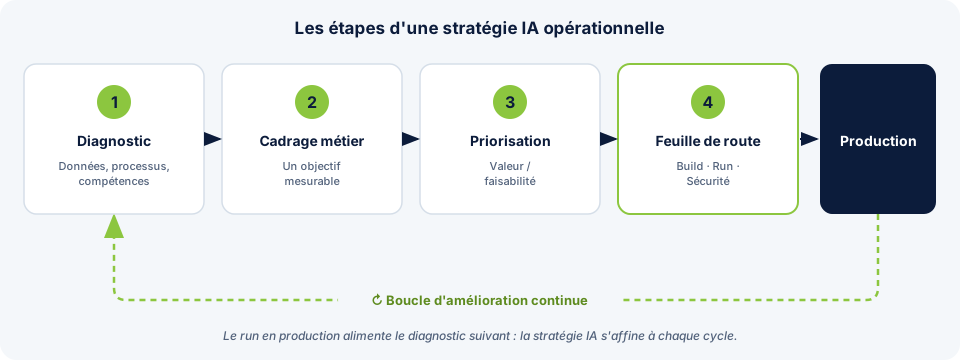
Les étapes d’une démarche IA opérationnelle
Diagnostic de maturité : données, processus, compétences
Tout commence par un état des lieux honnête. Où sont vos données, dans quel état, qui les gouverne ? Quels processus sont assez clairs pour être automatisés, lesquels restent flous ? Quelles compétences existent en interne, lesquelles manquent ?
La qualité des données est la cause racine la plus fréquente des échecs. Un modèle nourri de données incomplètes ou éparpillées produit des résultats que personne n’ose mettre en production. Avant de parler d’IA, il faut souvent fiabiliser le socle applicatif qui produit ces données. C’est le sujet que nous traitons dans notre article sur la façon de préparer vos processus métier à la data et à l’IA.
Cadrer l’IA sur un objectif métier, pas sur la tendance
Une stratégie IA ne part pas de la technologie, elle part d’un problème à résoudre. Réduire un délai de traitement, fiabiliser une saisie, absorber un volume qui déborde vos équipes, améliorer une réponse client : l’objectif doit être mesurable et rattaché à un enjeu réel.
Un cas d’usage sans indicateur de succès est une expérimentation, pas un projet. Formuler le résultat attendu en amont évite l’effet vitrine, où l’on empile des démonstrations sans jamais mesurer le gain. C’est aussi ce qui permet, plus tard, d’arbitrer et de justifier les investissements.
Prioriser les cas d’usage à forte valeur et faible risque
Vous ne pouvez pas tout lancer en même temps. La priorisation croise deux axes : la valeur métier attendue et la faisabilité réelle, qui dépend surtout de la disponibilité des données et du niveau de risque. On commence par les cas à forte valeur et faible complexité, souvent des processus internes bien cadrés.
Ces premiers succès financent la suite et installent la confiance. Ils démontrent la capacité de l’organisation à passer de l’idée au système, avant de s’attaquer aux chantiers plus lourds et plus exposés.
Construire la feuille de route : build, run et sécurité
Une feuille de route IA ne s’arrête pas à la livraison. Elle prévoit trois volets dès le départ. Le build conçoit et intègre la solution. Le run l’opère, la surveille et la corrige en production. La sécurité encadre les accès, les données et les décisions de l’IA, à tous les niveaux.
Le volet run est celui que les feuilles de route oublient le plus souvent. Un système d’IA vit, ses données évoluent, ses performances dérivent. Sans plan d’exploitation, le meilleur pilote se dégrade en silence jusqu’à ce que personne ne lui fasse plus confiance.
Choisir ses cas d’usage IA : la matrice valeur et faisabilité
La priorisation devient concrète quand on la pose sur une matrice. Deux axes suffisent : la valeur métier attendue et la faisabilité, c’est-à-dire la maturité des données et le niveau de risque acceptable. Chaque cas d’usage tombe dans un quadrant qui dicte la décision.
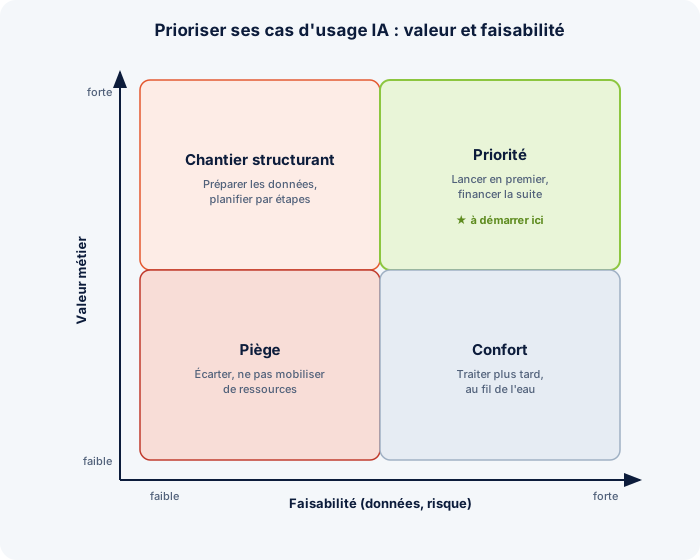
Concrètement, chaque quadrant correspond à des cas d’usage types :
- Priorité : synthèse automatique de comptes rendus de réunion, tri et routage des demandes entrantes, réponses de premier niveau au support interne.
- Chantier structurant : traitement de bout en bout des factures fournisseurs, assistant réglementaire adossé à vos données métier, aide à la décision sur des dossiers complexes.
- Confort : reformulation de contenus, aide à la rédaction de brouillons, traduction de documents internes.
- Piège : prédiction sur des données rares ou peu fiables, cas ultra-spécifique à très faible volume, automatisation d’un processus encore mal défini.
Le choix du cas d’usage détermine aussi le type d’IA à mobiliser. Un besoin de rédaction ou de synthèse appelle une IA générative supervisée. Un processus à exécuter de bout en bout appelle un agent autonome, avec un tout autre niveau d’exigence sur la fiabilité et le contrôle. Nous détaillons cette distinction dans notre comparaison entre IA agentique et IA générative.
Commencer par des cas d’usage internes reste la meilleure école. Le risque est maîtrisé, les utilisateurs sont vos propres équipes, et les enseignements se transposent ensuite aux processus tournés vers vos clients.
Gouvernance et sécurité : les conditions d’une IA en production
Gouvernance des données et conformité
Une IA en production manipule des données réelles, souvent personnelles ou sensibles. La gouvernance définit qui accède à quoi, dans quel but, et sous quelles règles de qualité. Sans ce cadre, aucun système ne franchit la revue juridique, et à raison.
Le RGPD encadre déjà le traitement des données personnelles. L’AI Act européen ajoute des obligations selon le niveau de risque de l’usage. Intégrer ces exigences dès le cadrage coûte infiniment moins cher que de les rattraper sur un système déjà déployé.
Supervision humaine et auditabilité
Une IA qui décide sans supervision est une IA que personne ne peut défendre le jour où une décision est contestée. La bonne pratique consiste à garder l’humain sur les décisions à enjeu, et à relâcher le contrôle sur les cas à faible risque une fois les résultats confirmés.
Cette supervision suppose de tout tracer : les données utilisées, les décisions prises, les corrections apportées. Sans journal, impossible de rendre des comptes ni de progresser. Nous développons ce principe dans notre article sur le human in the loop.
La sécurité comme condition, pas comme option
La sécurité n’est pas une couche que l’on ajoute à la fin. Accès aux données, cloisonnement des systèmes, contrôle de ce que l’IA a le droit de faire : ces choix sont structurants et doivent être posés dès l’architecture. Les rattraper après coup revient à refaire le projet.
C’est particulièrement vrai pour les agents autonomes, qui agissent dans vos systèmes. Un agent doit disposer des seules actions dont il a besoin, et de rien d’autre. La sécurité est ce qui autorise l’IA à sortir de la démonstration.
Mesurer le ROI et passer à l’échelle
Le retour sur investissement d’un projet IA se mesure sur l’indicateur défini au cadrage, pas sur une impression générale. Temps gagné, erreurs évitées, volume absorbé, satisfaction client : le gain se compare à la situation de départ, sur un périmètre borné.
Passer à l’échelle, ce n’est pas dupliquer un pilote. C’est l’industrialiser : le connecter proprement à vos applications, le rendre robuste aux cas imprévus et l’intégrer dans vos processus existants. Cette étape ressemble à toute modernisation d’un système d’information, où il faut décider quoi remplacer, connecter ou prolonger parmi vos outils.
Un pilote prouve une idée, un système la rend fiable et répétable. Entre les deux, il y a l’exploitation, la surveillance et l’amélioration continue. C’est ce travail, peu spectaculaire mais décisif, qui transforme une stratégie IA en résultats durables.
Déployer votre feuille de route IA avec Castelis
Entre une IA qui impressionne en réunion et une IA qui tourne en production tous les jours, il y a un écart que la plupart des projets sous-estiment. C’est précisément cet écart que nous traitons : cadrer les processus, choisir les bons cas d’usage, concevoir les systèmes, les sécuriser et les opérer dans la durée.
Castelis n’est pas une agence qui ajoute de l’IA à des projets. Nous transformons vos processus métier en systèmes numériques augmentés par l’IA, fiables, auditables et opérés en production. Avec plus de 500 projets livrés et plus de 25 ans d’expérience, nous accompagnons votre stratégie IA du premier cadrage jusqu’au run, à travers nos solutions d’intelligence artificielle.
Construisons ensemble votre feuille de route IA
Du diagnostic à la mise en production : nous cadrons, concevons, sécurisons et opérons vos systèmes d'IA avec le niveau de fiabilité qu'exige un usage réel.
FAQ
Qu’est-ce qu’une stratégie IA ?
Une stratégie IA est le plan qui définit où l’intelligence artificielle doit créer de la valeur dans une organisation, dans quel ordre, avec quelles données et sous quel contrôle. Elle relie les objectifs métier, la faisabilité technique et l’adoption par les équipes. Son but n’est pas de multiplier les expérimentations, mais d’amener des systèmes utiles jusqu’en production et de mesurer leur retour.
Comment définir une stratégie IA pour son entreprise ?
On commence par un diagnostic de maturité des données, des processus et des compétences. On cadre ensuite chaque cas d’usage sur un objectif métier mesurable, puis on priorise selon la valeur et la faisabilité. La feuille de route prévoit dès le départ la conception, l’exploitation en production et la sécurité, plutôt que de renvoyer ces sujets à plus tard.
Combien de temps faut-il pour déployer une stratégie IA ?
Il n’y a pas de délai unique, cela dépend de la maturité des données et de l’ambition du cas d’usage. Un premier cas d’usage interne et bien borné peut produire un résultat mesurable en quelques semaines. L’important n’est pas la vitesse, mais de choisir un périmètre assez restreint pour aller jusqu’à la production et prouver la valeur avant d’étendre.
IA générative ou IA agentique : que choisir dans sa stratégie ?
Cela dépend du cas d’usage. L’IA générative convient aux tâches de rédaction, de synthèse ou d’assistance, sous supervision humaine. L’IA agentique convient aux processus à exécuter de bout en bout, avec une exigence bien plus forte sur la fiabilité, la sécurité et le contrôle. Une stratégie IA mature combine souvent les deux, chacune sur les cas d’usage où elle est la plus adaptée.
 Équipe Access it
 7 min
7 min
 24 Sep 2026