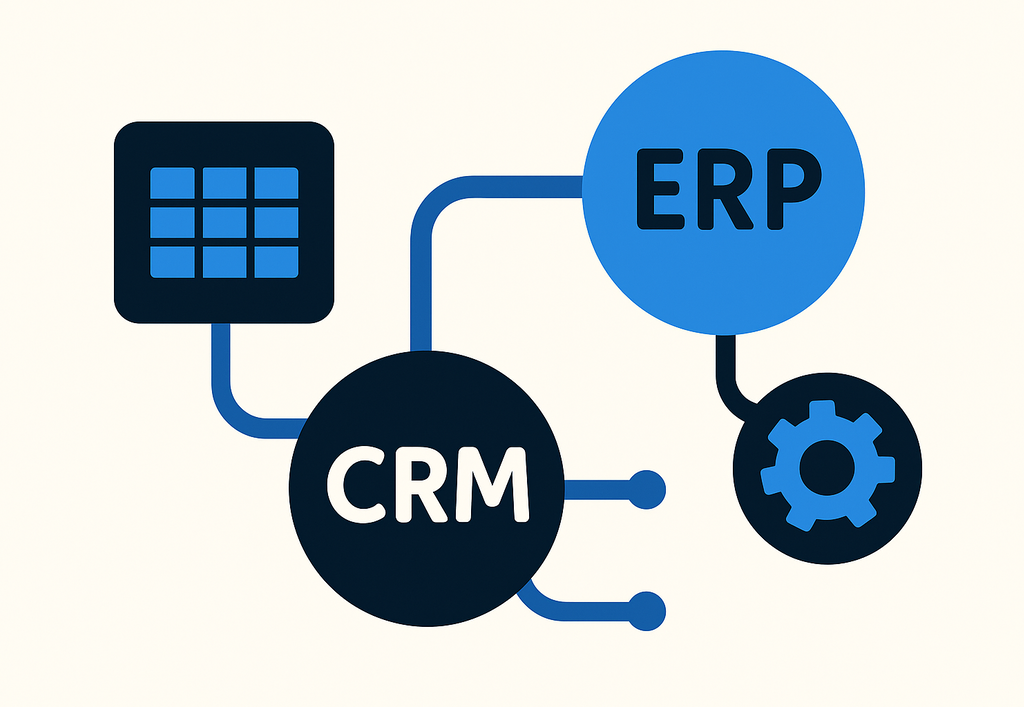


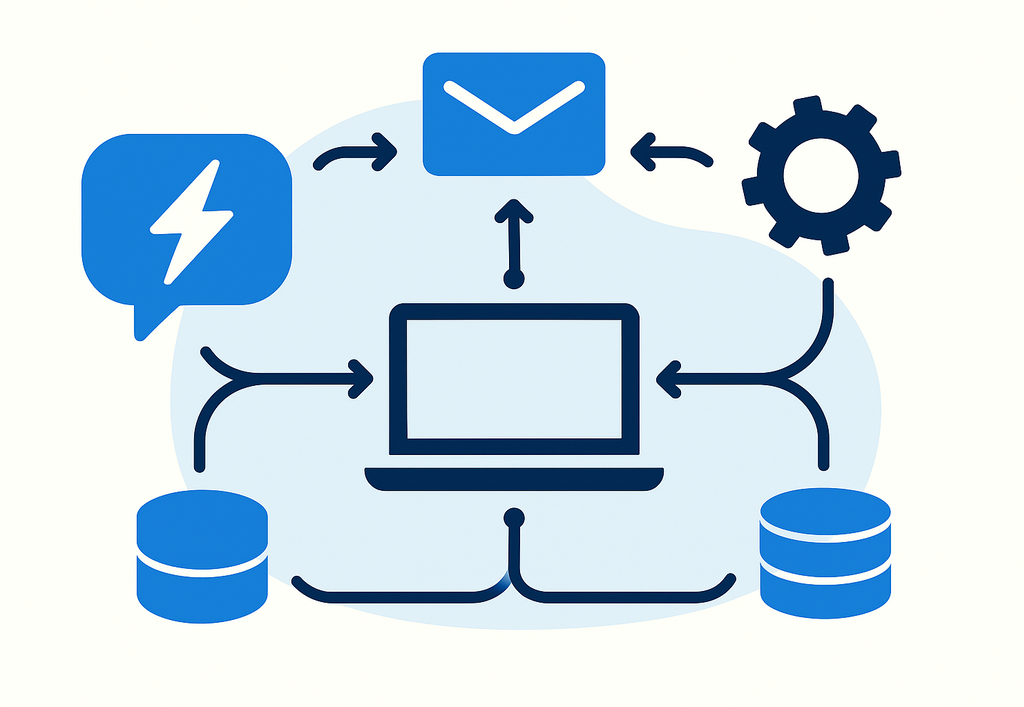



An order validated in the CRM has to be re-entered in the ERP, then passed to billing, then reconciled in a reporting tool. At each manual handoff, the company loses time and increases the risk of error. It’s not a tool problem: it’s a flow problem.
The performance of an information system isn’t measured tool by tool alone. It’s measured by the way data flows between them. That’s where business application integration becomes a concrete lever to make processes reliable, cut hidden costs, and prepare for Data and AI uses.
This subject is often seen as technical. It is, of course. But it’s also deeply about the business. Behind every poorly synchronized flow, there’s a team re-entering data, an indicator arriving too late, a customer record that diverges, or a decision made on incomplete information.
When the tools work… but not together
Many companies have a good CRM, a good ERP, and a good reporting tool. And yet their processes remain inefficient, because data doesn’t pass automatically from one system to another.
A customer created in the CRM but absent from the ERP. A validated quote that doesn’t automatically turn into an order. An invoice generated without feedback to the salesperson. Stock updated too late. A dashboard fed by manual exports reworked every week.
These situations have one thing in common: the information exists somewhere in the IS, but it doesn’t arrive at the right place, at the right time, in the right format. The problem isn’t in the tools. It’s in the empty spaces between them.
These empty spaces often end up filled by the teams themselves: an Excel export, a manual check, a copy-paste, a rule passed on verbally, a follow-up by email. The process keeps working, but it works thanks to invisible compensations. And the more the company grows, the more costly these compensations become.
The invisible consequences of broken flows
Re-entry often seems acceptable from the outside. “It takes ten minutes a day.” In reality, this hidden cost adds up: data-entry errors, delays between departments, customer disputes over contradictory information, indicators produced late on partially reworked data.
There’s also a less quantifiable impact: the loss of trust in the data. When teams know that the figures from one tool don’t always match those from another, they stop relying on them. They create their own tracking files, which worsens fragmentation instead of reducing it.
This cycle breaks by tackling the source: the quality and fluidity of the exchanges between applications.
The real risk isn’t only operational. It can also become managerial. If each department has its own version of the truth, trade-offs get harder. Sales, finance, production, and support no longer look at the same data. Integration then becomes a lever of consistency, not just an automation topic.
What a good integration must really do
Integrating two applications isn’t just about “plugging” one into the other. A robust integration handles far more than the simple transfer of data.
It manages the transformation rules between different formats, access rights across systems, error handling and recovery in case of failure, deduplication of entries, logging of exchanges for traceability, and the business edge cases that match no standard scenario.
It’s a subject that is both technical and functional. Designing effective integration requires understanding the business processes as much as the architecture constraints. That’s precisely the approach Access it advocates in its application integration expertise: automatically synchronizing ERP, CRM, e-commerce, and management tools to remove manual entry, reduce errors, and streamline processes end to end.
The real difficulty isn’t always getting a piece of data from one tool to another the first time. It’s guaranteeing that the flow stays reliable over time. What happens if the ERP is temporarily unavailable? If a mandatory field is missing? If two tools don’t use the same customer reference data? If a job fails in the middle of the night? These cases aren’t technical details. They’re what makes the difference between an automation that’s comfortable in a demo and a process that’s truly secured in production.
A good integration must therefore also know how to fail cleanly: flag the error, keep a trace of the exchange, allow a retry, avoid duplicates, and not let users discover the problem several days later in an inconsistent report.
Your tools don't talk to each other yet?
Access it designs and operates the integrations between your business applications to remove re-entry, make data reliable, and streamline your processes.
Integration and cybersecurity: a subject to frame from the start
The more applications communicate with each other, the larger the exposure surface grows. A poorly designed integration can become a vulnerability vector: insufficient authentication, sensitive data exposed on unsecured APIs, no logging of access.
The security of an integration is considered from the design stage: encryption of exchanges, fine-grained rights management per application and per flow, monitoring of API calls, alerts in case of abnormal behavior. It’s not a layer you add afterward.
This is a particularly structuring point for companies that handle financial, customer, or regulated data. Governance of the flows between applications is an integral part of an IS security policy.
The challenge isn’t to block the exchanges, but to master them. Data that flows better must also flow within a clearer framework: who can send it, who can receive it, how often, in what context, with what level of traceability. It’s this rigor that makes it possible to automate without weakening.
A concrete example: streamlining an Order-to-Cash process
Take a classic Order-to-Cash process: creating the quote in the CRM, sales validation, conversion into an order, invoicing, payment tracking, updating the financial reporting. Six steps that, without integration, involve as many manual handoffs.
A well-designed integration on this flow makes it possible to automatically trigger the creation of the order in the ERP as soon as the quote is validated in the CRM. The invoice is generated without re-entering customer data. The payment status flows back automatically to the salesperson. The financial reporting is fed in real time, without a weekly export.
The result: fewer errors, reduced lead times, teams working on reliable data that’s consistent across departments. And a finance department that has an up-to-date view without waiting for the month-end consolidation. That’s exactly the kind of transformation that Access it’s support for finance departments aims to produce.
In this type of project, the benefit isn’t limited to time savings. It also touches the quality of steering. When commercial, operational, and financial data are aligned, decisions become faster and more reliable. Discrepancies are detected earlier. Disputes are easier to understand. Teams spend less time reconciling information, and more time acting on it.
Integration and data: preparing the ground for Data and AI
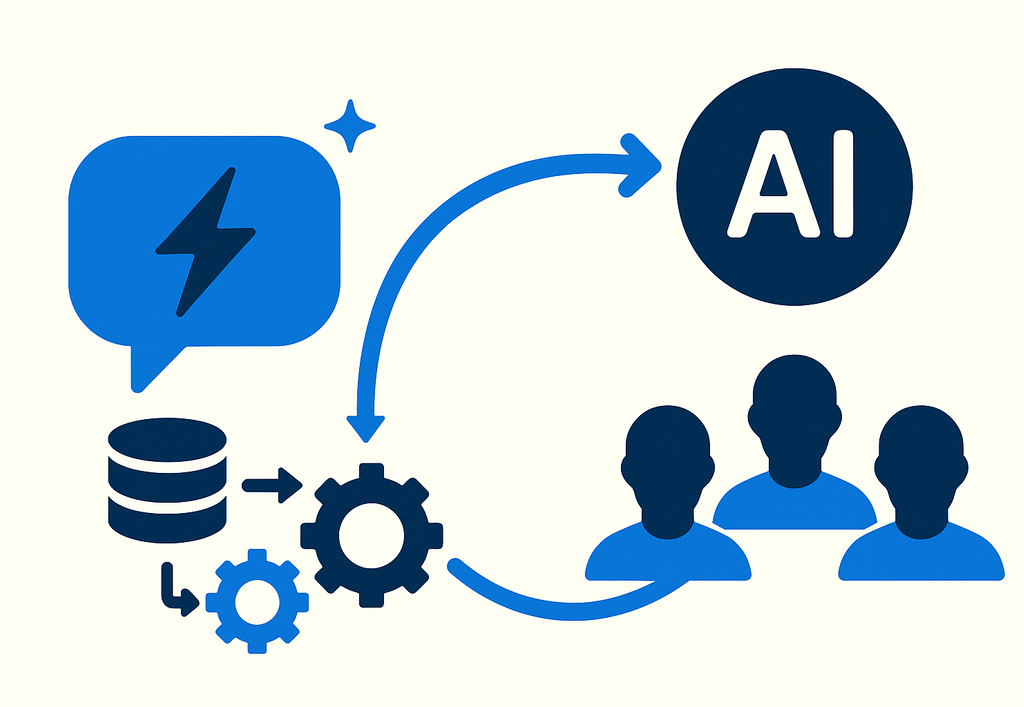
An often-underestimated benefit of integration: it prepares Data and AI uses. Data that is well structured, correctly synchronized across tools, and kept over time becomes usable for advanced dashboards, predictive analyses, or intelligent automations.
Conversely, trying to deploy AI on an IS where data is scattered, inconsistent, and partially reworked by hand produces unreliable results. Integration is therefore often a logical, and even necessary, step before considering any serious Data or AI project.
It’s the natural progression of the series: make processes reliable, connect the tools, then and only then augment with analytical or automated capabilities.
Conclusion
Integration is often less visible than a new application. It doesn’t always change the interfaces users see. But it’s sometimes more transformative than replacing a tool, because it tackles the real problem: the quality and fluidity of how data circulates.
Well designed, it lets existing tools form a genuinely coherent, reliable, and scalable business ecosystem. And it lays the foundations on which Data and AI projects can produce real results.
The performance of an information system therefore doesn’t rest solely on the richness of each application. It also rests on the way these applications work together, over time, with flows that are reliable, secure, and understandable by the teams.
 Équipe Access it
 7 min
7 min
 24 Sep 2026