

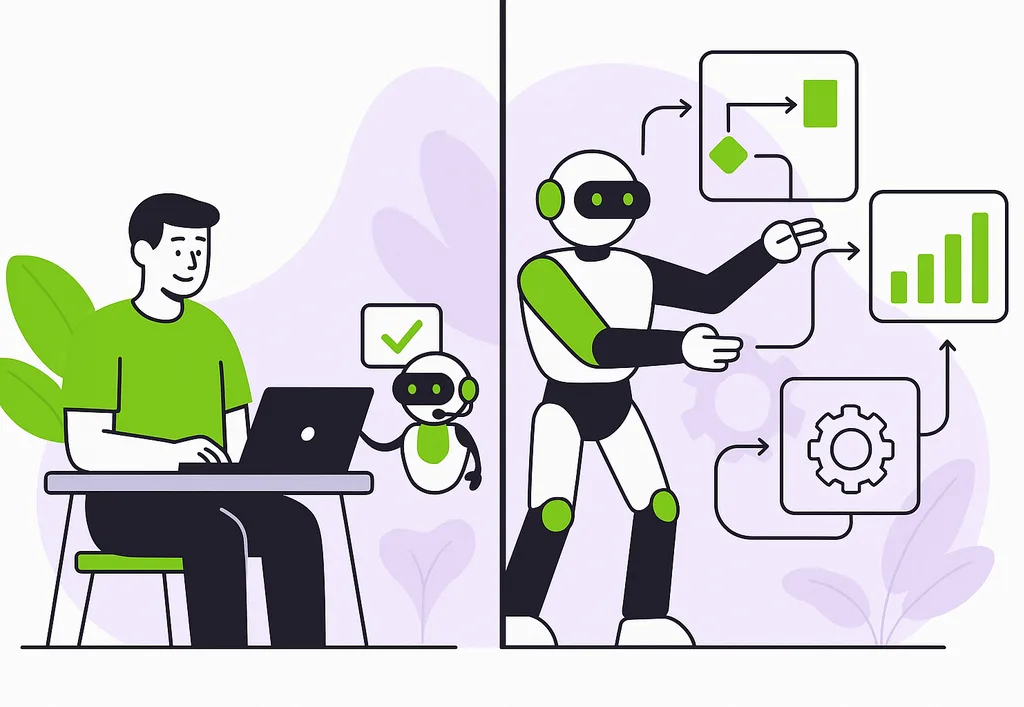



AI agent, AI assistant: both terms circulate in every leadership meeting, often as synonyms. They are not. One helps your teams work faster, the other runs a process on their behalf. Confusing the two leads to the wrong project: a copilot where you needed automation, or an autonomous system where an assistant would have been plenty.
This article clarifies the difference between an AI agent and an AI assistant, their concrete enterprise use cases, and above all how to choose the right one for your business process. The goal: an actionable decision framework, all the way to production, the stage where most AI projects stall.
AI assistant and AI agent: two levels of autonomy not to confuse
What is an AI assistant?
An AI assistant is an application that helps an employee complete a task, in a conversational way. It usually relies on generative AI without being the same thing: generative AI is the model that produces the content, the assistant is the product built around it. It adds an interface, context memory, and access to your data or tools.
Concretely, the assistant understands your request, fetches the relevant information, and proposes a result. But it stays reactive: it waits for your instructions and lets you validate. The decision and the responsibility remain on the human side.
What is an AI agent?
An AI agent is proactive. It receives an objective, plans the steps, executes actions across your systems, observes the result, and adjusts. It does not wait for an instruction at each step.
Where the assistant suggests, the agent acts: it opens a ticket, updates a CRM, triggers an order, follows up with a customer. This execution autonomy is the fundamental difference between an AI agent and an AI assistant.
And what about the chatbot (and generative AI)?
Three terms often get mixed up. The chatbot is the ancestor: it follows scripted scenarios and answers within a closed scope. Generative AI is the underlying technology, the model that produces text, code, or images. Both the assistant and the agent usually build on it.
In other words, generative AI is the engine. The assistant and the agent are two different vehicles built around it. The confusion is so widespread that Gartner coined a term for it, “agent washing”: vendors rebrand a simple assistant, an RPA bot, or a chatbot as an “agent.” For the deeper distinction between producing content and acting autonomously, we explored it in our comparison of agentic AI and generative AI.
AI agent vs AI assistant: the comparison table
The distinction reads more clearly across a few operational criteria.
| Criterion | Chatbot | AI assistant | AI agent |
|---|---|---|---|
| Trigger | Keyword or script | On user request | On objective, then autonomous |
| Level of autonomy | None | Low to moderate (human validates) | High (decides and acts) |
| Scope of action | Predefined answers | Content generation, suggestions | Actions across the IS, end to end |
| System integration | Low | Medium (read, assist) | High (read and write, multi-system) |
| Human supervision | Not needed | Systematic (validation) | By exception (guardrails, escalation) |
| Memory and context | None | Contextual, occasional | Contextual, multi-step |
| Typical example | Automated FAQ | Writing copilot | Claims-handling agent |
The table shows a progression of autonomy, not a list of competing tools. The right choice depends on the target process, not on the most advanced category.
Use cases for the AI assistant and the AI agent in the enterprise
AI assistant use cases
The AI assistant shines on tasks where the human must stay in control.
- Writing and summarizing: meeting notes, emails, sales proposals.
- Decision support: contract analysis, customer file summary, document search.
- First-level support: reply suggestions for an agent, without automatic sending.
The common thread: the assistant prepares, the human decides. Operational risk stays low, deployment fast.
AI agent use cases
The AI agent takes on complete processes, where value comes from autonomous execution. In customer service, it qualifies a complaint, checks the order, triggers the refund, and notifies the customer. In finance, it reconciles invoices, flags discrepancies, and prepares follow-ups. On the IS side, it monitors alerts, isolates an incident, and opens an enriched ticket. These processes often run through the mailbox, which means giving the agent a properly scoped email access.
These use cases share one thing: the agent acts within your systems and commits the company on your behalf. That is what creates its value, and also what determines its success. Gartner expects 33% of enterprise applications to embed agentic AI by 2028, up from less than 1% in 2024. But the firm also predicts that over 40% of agentic AI projects will be canceled by the end of 2027, due to unclear value, runaway costs, or insufficient guardrails. So it is not the most autonomous agents that will prevail, but those that are governed and deliver real value.
AI assistant or AI agent: how to choose for your business process
The choice is not about the technology, but about the process to equip. Four criteria guide the decision.
- Nature of the need: help a human who decides, or execute a process on their behalf? This is the tipping point between assistant and agent.
- Data and system maturity: an agent needs reliable access and usable APIs. Without them, start with the assistant.
- Criticality: would an error have a major financial, legal, or customer impact? The more critical, the more autonomy must be supervised.
- Expected ROI: the assistant saves time, the agent removes steps. One optimizes, the other transforms.
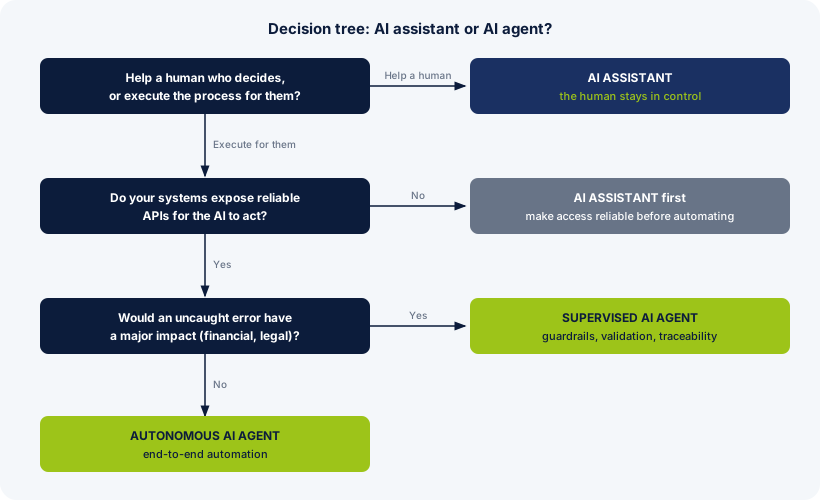
In practice, many companies start with an assistant on a controlled scope, then evolve their most mature processes toward agents. This progressive path limits risk.
AI assistant or AI agent: unsure about your case?
We frame the right level of autonomy for your processes and operate your AI solutions in production.
From assistant to agent: succeeding in production
Reliability, supervision, and auditability
An agent that works in a demo is not an agent ready for production. The challenge is not to make it work once, but to guarantee reliable, supervised, and traceable behavior over time.
Three requirements structure this transition:
- Supervision: define what the agent does on its own and what requires human validation.
- Auditability: log every decision with its context, so it can be explained afterward.
- Resilience: anticipate failure cases and a way to cut off autonomy at any time.
These mechanisms are a matter of architecture, a topic we covered in our article on software architecture in the age of agentic systems.
Security and governance of AI agents
An agent that acts within the IS becomes a new attack surface. It holds access, makes decisions, and can be hijacked. Classic access controls are no longer enough: you need business guardrails, an allowlist of permitted actions, and escalation rules.
Governance is not optional. It drives compliance, notably under the EU AI Act, and the trust of business teams. It is often this part, handled too late, that blocks the move to production.
Industrializing your AI agents in production with Castelis
This is exactly where Castelis comes in. Many players stop at the prototype or the demo. We design, secure, and operate AI assistants and agents all the way to production, with the supervision and traceability that real-world use demands.
With over 500 projects delivered and more than 25 years of experience, we support CIOs and business leaders across the whole journey: framing the right level of autonomy, integrating into the existing IS, governance, and run. See how our AI solutions design and operate your AI agents in production.
FAQ
Is an AI agent the same as an AI assistant?
No. An AI assistant reacts to your requests and lets you decide. An AI agent pursues an objective and executes actions autonomously. The difference lies in the level of autonomy and the ability to act within your systems, not in the underlying technology, which is often common to both.
What is an AI assistant?
An AI assistant is a tool that helps an employee complete a task: write, summarize, translate, analyze, answer. It is reactive and stays under human control. Productivity copilots are the most widespread example in the enterprise.
What is the role of an AI agent?
The role of an AI agent is to reach a set objective by planning and executing the necessary steps, without continuous human intervention. It interacts with your applications, makes intermediate decisions, and adapts to the result. Its value: automating a complete process, not just an isolated task.
How do you build an AI agent in the enterprise?
Building an AI agent starts from a precise business process, not from a technology. You define the objective, the authorized actions, the system access, and the human control points. Then comes integration into the IS, followed by the move to production with supervision, logging, and guardrails. It is this last stage, the most demanding, that separates a truly operational agent from a mere demo.
 Équipe Castelis
 11 min
 08 Sep 2026