




AI is becoming more autonomous, yet it still makes mistakes, sometimes with financial, legal or reputational consequences. For a decision-maker, the real question is not whether humans remain useful, but where to place them in the decision chain. That is exactly what human in the loop is about: keeping human intervention at the right points, without throttling the value of automation.
This article clarifies what human in the loop really covers, how this supervision loop works, and above all how to choose the right level of control depending on how critical your processes are. The goal: a concrete decision framework, from the regulatory context all the way to production.
Human in the loop (HITL): definition
Human in the loop, or HITL, refers to an approach to AI in which a human steps in at key moments of an automated system’s operation. The phrase captures the idea well: the person is not a bystander, they are part of the decision loop and their judgment shapes the outcome.
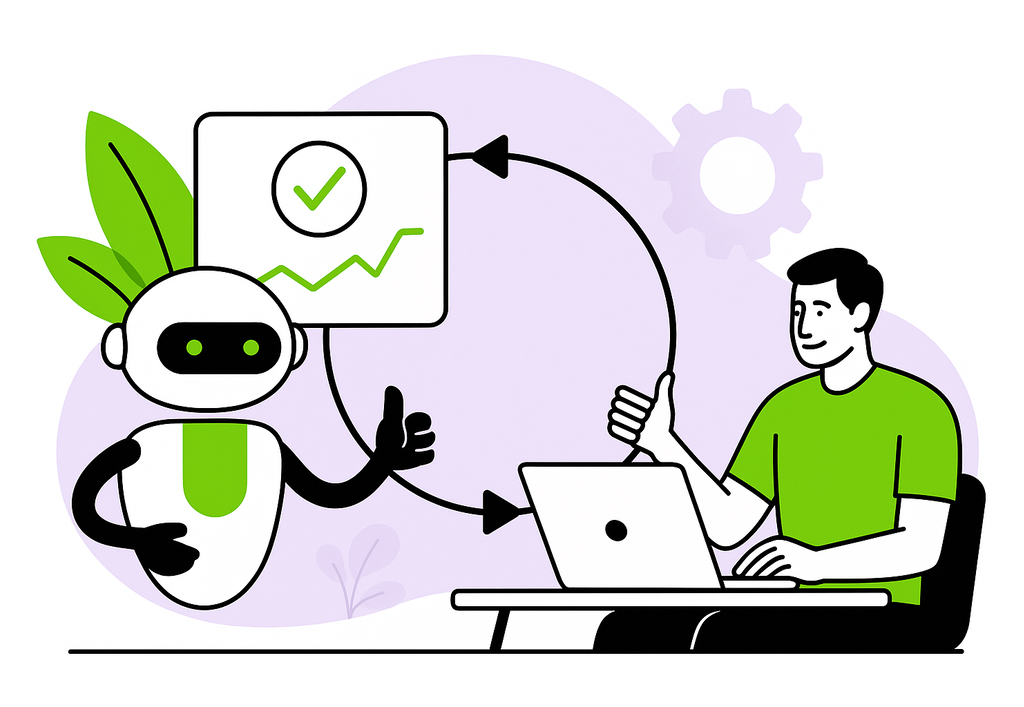
In practice, the system produces a proposal, and a human validates, corrects or rejects it before it has any effect. This validation serves several goals: making results more reliable, filtering out bias, ensuring compliance and keeping accountability clear. Human in the loop is therefore not a minor safeguard, it is an architectural choice.
How a human in the loop approach works
The feedback loop: data, prediction, validation, improvement
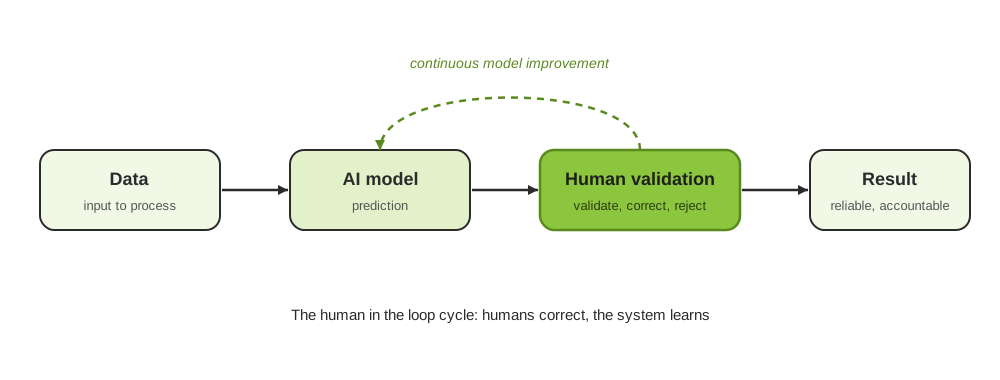
The human in the loop principle rests on a continuous feedback loop. The system processes data and proposes a result, an expert reviews and corrects it, then that correction feeds back into the system to improve future performance. The loop repeats, and quality rises as the hard cases are settled by a human.
From training to production validation: where humans step in
Humans can intervene at several stages of an AI system’s lifecycle. During training, they label data and steer the model, for example through RLHF (Reinforcement Learning from Human Feedback), the reinforcement learning method that shaped today’s large language models. This logic applies to generative AI as much as to more classic decision systems.
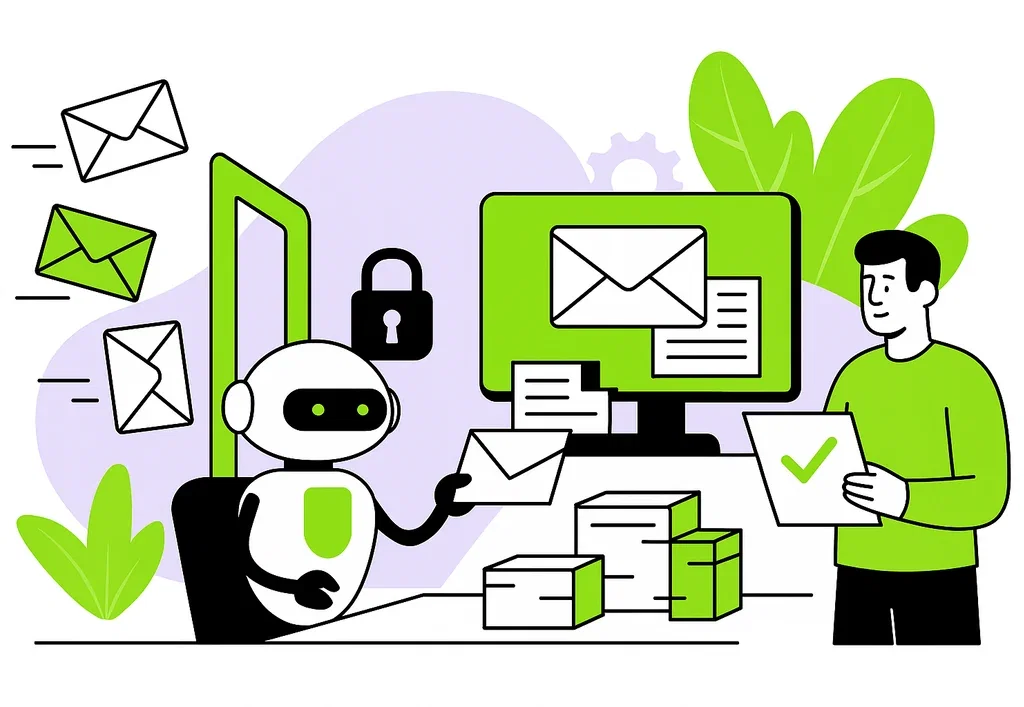
In production, human in the loop takes another form: validation on the fly. The human approves a sensitive action, clears up an ambiguous case or blocks a risky decision. It is this operational supervision, not the initial labeling, that becomes decisive once AI acts inside your business systems. In practice, that validation often runs through a channel everyone already knows: an AI email agent that submits its proposal and waits for the owner’s reply.
Where should humans sit in your AI systems?
We frame the right level of supervision for your processes and operate your AI solutions in production, with the guardrails real-world use demands.
In the loop, on the loop, out of the loop: the supervision spectrum
“Human in the loop” is often used as a catch-all, when in fact there are three distinct levels of supervision. Confusing them leads to miscalibrated control: too heavy, it throttles automation, too light, it exposes the business.
| Criterion | Human in the loop | Human on the loop | Human out of the loop |
|---|---|---|---|
| Human’s role | Validates before the action | Supervises during the action | No real-time intervention |
| Timing of control | Before every decision | On exception or anomaly | After the fact (audit, logs) |
| System autonomy | Low | High, under supervision | Full |
| Speed and scaling | Limited | Good | Maximal |
| Typical case | Medical diagnosis, credit | Fraud detection, agent supervision | Recommendations, low-stakes triage |
| Risk level | Controlled | Bounded | To monitor |
With the rise of agentic AI, the trend is to move from a human “in” the loop to a human “on” the loop, as systems become more reliable. This trajectory follows the logic of growing autonomy we detail in our comparison of the AI agent and the AI assistant.
Why human in the loop is strategic for the enterprise
Keeping a human in the loop is not a brake on AI, it is what makes it deployable on high-stakes processes. The benefits are operational as much as strategic.
- Accuracy: humans correct the cases the model handles poorly, especially novel or ambiguous situations.
- Bias control: an expert eye filters out the drifts that imperfect training data can introduce.
- Compliance and accountability: a human-validated decision stays explainable and attributable, which matters to regulators.
- Business trust: teams adopt a system more readily when they can control and correct it.
There is a flip side: human validation has a cost and slows processing. The whole art is to focus human intervention where it creates value, and to lighten it where the risk is low. That is an engineering decision as much as a governance one, as we illustrate in our field report on AI agents in production.
Human in the loop and compliance: what the AI Act requires
Human in the loop is no longer just good practice, it is becoming a requirement for certain uses. Article 14 of the EU AI Act requires that high-risk AI systems can be effectively overseen by natural persons, able to understand, interpret and stop the system when needed.
The text expects oversight proportionate to the risk, the autonomy and the context of use. In concrete terms, the more an automated decision affects people’s health, rights or safety, the higher the level of human control must be. Anticipating this requirement from the design stage avoids stalling the move to production for lack of governance.
Human in the loop or full automation: how to choose
The right level of supervision cannot be decreed, it follows from the process to be supported. Four criteria guide the choice between keeping a human in the loop, placing them on the loop, or aiming for full automation.
- Criticality: does an error carry a major financial, legal or human impact? The more critical it is, the more the human stays in the loop.
- Volume and speed: high throughput makes systematic validation untenable and pushes toward supervision by exception.
- System reliability: a proven, measured model allows control to be relaxed, a young system does not.
- Regulatory framework: for high-risk uses, the minimum level of supervision is imposed, not optional.
In practice, most organizations start with a human fully in the loop, then relax control as trust and metrics build up. This gradual path, from “in” to “on”, limits risk while capturing the gains of automation.
Putting human in the loop into production with Castelis
This is exactly where Castelis comes in. Many players stop at the prototype, where human in the loop is little more than a demo. We design, secure and operate AI systems all the way to production, with the supervision, guardrails and traceability that real-world use demands.
With more than 500 projects delivered and over 25 years of experience, we support CIOs and business leaders across the whole journey: choosing the right level of supervision, integrating with the existing IS, compliance and run. Discover how our AI expertise designs and operates your supervised AI systems in production.
FAQ
What does human in the loop (HITL) mean?
Human in the loop refers to an approach to AI where a human steps in at key stages of an automated system, to validate, correct or reject its results. The human is part of the decision loop: their judgment shapes the final outcome, which makes the system more reliable and keeps accountability clear.
What is the difference between human in the loop and human on the loop?
In human in the loop, the human validates before each action: the system does not complete it without their approval. In human on the loop, the system acts on its own and the human supervises from the outside, stepping in only on exceptions or anomalies. The first maximizes control, the second maximizes scaling.
Is human in the loop mandatory under the AI Act?
For high-risk AI systems, Article 14 of the AI Act requires effective human oversight, proportionate to the risk and the context of use. The exact level of control depends on the system, but a complete absence of human oversight is not compliant for these sensitive uses.
Does human in the loop slow AI down?
Human validation has a cost in time, true on large volumes. The answer is not to remove it, but to target it: keep the human in the loop on critical decisions, and switch to supervision by exception on low-stakes tasks. That preserves speed without giving up control.
 Équipe Castelis
 11 min
 08 Sep 2026