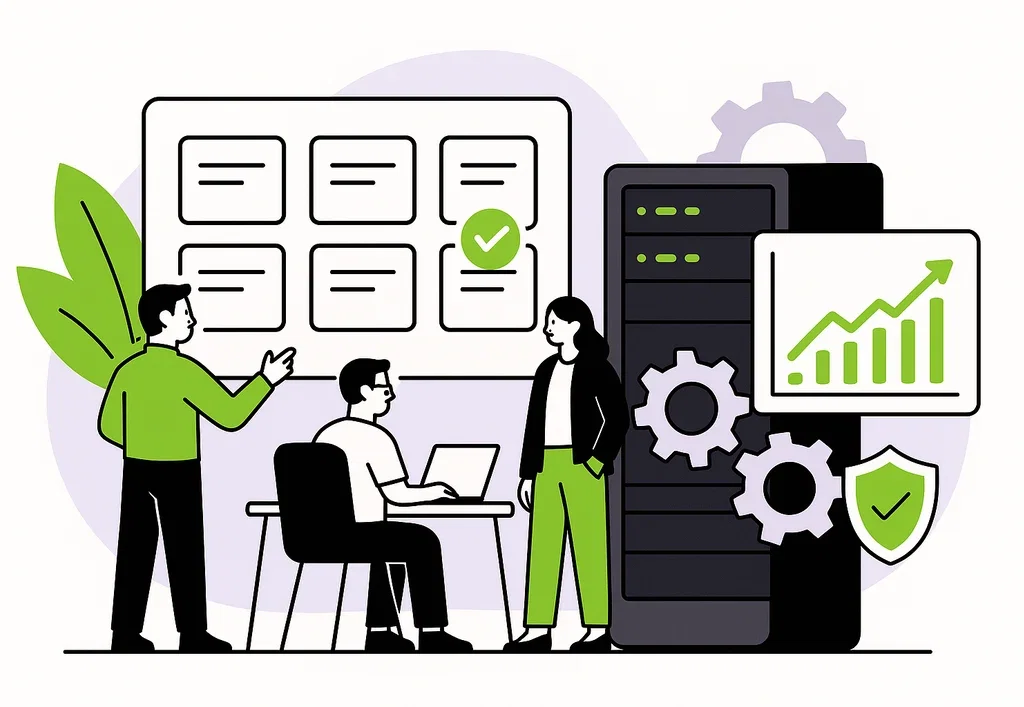






AI Shifts from Copilot to Pilot
AIOps has transformed IT operations by bringing prediction and intelligent correlation. Anomaly detection, automated root cause analysis, reduced alert fatigue: major advances.
But AIOps remains fundamentally a recommendation system. It detects, analyzes, and suggests. Humans decide and execute.
A new wave is arriving: autonomous AI agents. These systems no longer merely observe. They plan, coordinate, act, and learn. The AI agents market is estimated at $5 billion in 2024 and expected to reach $50 billion by 2030 (IBM).
The problem: how to manage systems that “think” and act autonomously? How to ensure reliability, security, and control when AI makes decisions and executes actions in real-time?
The answer: AgentOps, the operational discipline for autonomous AI agents.
What is AgentOps?
AgentOps refers to the set of practices for designing, deploying, monitoring, optimizing, and governing autonomous AI agents in production.
Autonomous AI Agent: Beyond the Model
An autonomous AI agent is not just a machine learning model. It’s a system that:
- Perceives its environment (data, events, context)
- Makes decisions independently
- Acts via external tools (APIs, databases, enterprise systems)
- Learns and adapts based on results
Example: a customer support agent doesn’t just generate a response. It analyzes the ticket, queries multiple knowledge bases, decides necessary actions (create escalation ticket, modify config, send email), executes these actions, verifies the result, and closes the ticket.
AgentOps: The Logical Evolution of Ops
AgentOps follows in the lineage of DevOps and MLOps, but goes further:
- DevOps: Deliver software quickly and reliably
- MLOps: Deploy and maintain ML models in production
- AgentOps: Manage systems that reason, decide, and act autonomously
The difference is fundamental. We’re no longer managing static code or passive models. We’re supervising systems that have “a mind of their own”.
AIOps vs AgentOps: The Conceptual Rupture
The difference between AIOps and AgentOps is not incremental. It’s a paradigm shift.
Direct Comparison
| Dimension | AIOps | AgentOps |
|---|---|---|
| AI Role | Intelligent assistant enriching human decision-making | Autonomous operator that makes and executes decisions |
| Workflow | Detect → Analyze → Suggest → Human decides and acts | Detect → Analyze → Decide → Act → Verify → Learn |
| Outputs | Enriched alerts, dashboards, recommendations | Executed actions, orchestrated workflows, measured results |
| What’s Supervised | IT systems (infrastructure, applications, networks) | Autonomous agents managing these systems |
| Complexity | Multi-source event correlation | Multi-step reasoning chains, multi-agent coordination |
Concrete Example
Scenario: API latency spike detected at 2:37 PM
With AIOps:
- System detects +500ms latency
- Correlates with database saturation (connection pool at 95%)
- Identifies probable cause: v2.3.1 deployment 12 minutes ago
- Generates enriched alert: “Critical incident. Suggested action: scale up RDS or rollback deployment”
- Awaits human validation
- Engineer reviews, decides, executes (10-15 minutes)
With AgentOps:
- Agent detects +500ms latency
- Analyzes cause: DB saturation linked to v2.3.1 deployment
- Decides: rollback safer than scaling (similar historical pattern)
- Executes automatic rollback to v2.3.0
- Verifies resolution: latency returned to 80ms in 45 seconds
- Logs entire action sequence
- Informs team with complete context
- Stores experience for future learning
- Total time: 2 minutes
The key: AgentOps doesn’t directly manage IT infrastructure. It manages agents that manage IT infrastructure.
The 4 Pillars of AgentOps
Observability: Seeing Inside the “Black Box”
AI agents are non-deterministic. The same input can produce different outputs depending on context, history, available tools. This variability is inherent to probabilistic models.
What needs to be traced:
- Each reasoning step (why the agent chose this path)
- Each tool or API call (with parameters and results)
- Each intermediate decision
- Token usage, latency, cost per task
- Context window used (agent’s memory)
The challenge: Massive data volume. An agent processing 1000 tasks/day can generate millions of trace events. Real-time logging is expensive but essential for debugging and auditing.
Emerging standards: OpenTelemetry (OTEL) is becoming the de facto standard for AI agent instrumentation, enabling unified traceability across frameworks (LangChain, AutoGen, CrewAI).
Governance: Autonomy Under Control
Agents act autonomously. How to ensure they respect business, legal, and ethical rules?
Guardrails: Defined limits on what the agent can and cannot do. Example: a financial agent cannot execute transactions over $10,000 without human validation.
Human-in-the-loop (HITL): Mandatory validation points for high-risk decisions or high uncertainty. The agent stops, requests confirmation, then continues.
RBAC (Role-Based Access Control): Who can deploy, modify, or deactivate which agents? Separation of responsibilities between developers, ops, and business.
Complete audit trails: Every action, every decision must be traceable for regulatory compliance (GDPR, EU AI Act, SOC2).
Example: HR agent analyzing applications. Guardrail: cannot reject candidates on discriminatory criteria (age, gender, origin). HITL: final hiring decision remains human. Audit: every recommendation logged with justification.
Evaluation: Measuring Performance
How to evaluate a non-deterministic system? Traditional metrics (latency, uptime, error rate) are no longer sufficient.
AgentOps Metrics:
- Task success rate: Percentage of successfully completed tasks
- Reasoning consistency: Does the agent reach the same conclusions for similar inputs?
- Tool usage efficiency: Number of API calls needed to accomplish a task
- Cost per task: Cost in tokens/compute per completed task
- Safety violations: Number of times the agent attempted a forbidden action
Rigorous testing:
- Standardized benchmarks (reference datasets)
- Adversarial scenarios (edge cases, malicious inputs)
- A/B testing between agent versions
- Session replay for post-mortem analysis
Continuous evaluation: Agents evolve in production. Their performance must be measured continuously, not just at initial deployment.
Continuous Optimization: Agents Learn
AgentOps is not “deploy and forget”. Agents must continuously improve.
Feedback loops:
- Explicit user feedback (thumbs up/down, corrections)
- Outcome tracking (did the task actually solve the problem?)
- Reinforcement learning from human feedback (RLHF)
- A/B testing on prompts, configs, reasoning strategies
Strict versioning:
- Versioned prompts (like code)
- Versioned configurations
- Versioned LLM models
- Rollback possible at any time
Improvement loop: Observe → Evaluate → Identify weaknesses → Optimize → Deploy new version → Observe…
The Unique Challenges of AgentOps
Non-Determinism and Reasoning Complexity
Agents are not predictable. The same input can trigger different execution paths. An agent can chain 10, 20, 50 reasoning steps before its final output. Tracing the entire chain, identifying where it went wrong, understanding why a decision was made: it’s a major technical challenge. Debugging resembles ghost hunting. LLM models operate as black boxes. Extracting a clear and reliable explanation of a decision made by an agent remains difficult.
Coordination and Governance at Scale
Multiple collaborating agents create new risks. Conflicts between agents, work duplication, deadlocks. Orchestrating dozens or hundreds of agents interacting with legacy systems (CRM, ERP, internal APIs without proper documentation) demands strict governance. Who can deploy which agents? Which actions require human validation? How to audit 1000 autonomous decisions per day? Integration with existing systems is rarely plug-and-play. Agents must authenticate, respect data policies, handle errors from unstable external systems.
Costs and Skills
An agent in an infinite loop can consume thousands of dollars in tokens before anyone notices. Circuit breakers are necessary but complex to calibrate. Complete observability generates massive log volumes, with associated storage and processing costs. On the human side: hybrid profiles capable of DevOps, ML, LLM, and governance are rare. AgentOps playbooks are still emerging. Explaining “why the agent made this decision” to an auditor or regulator remains a major challenge, slowing adoption in highly regulated environments like finance, healthcare, or manufacturing.
AgentOps Use Cases in Enterprise
AgentOps adoption is accelerating. According to Futurum Research, 12-18% of organizations have already formalized AgentOps practices, particularly in regulated sectors, advanced AI labs, and digitally native companies. 45% of large enterprises plan to launch AgentOps pilots within the next 18 months.
Concrete Use Cases
Autonomous customer support: Agents that analyze tickets, query knowledge bases, execute corrective actions (password reset, config modification), and close tickets without human intervention.
Cloud FinOps: Agents that detect underutilized resources, recommend optimizations, and automatically execute changes (downsize instances, delete orphaned volumes) with budgetary guardrails.
Threat analysis and response: Security agents that detect abnormal behaviors, analyze logs, isolate compromised machines, block suspicious IPs, and generate detailed incident reports.
R&D co-pilots: Agents that assist software development (automatic code review, test generation, bug detection), accelerating development cycles.
Claim processing (insurance): Agents that analyze claims, verify documents, calculate compensation according to business rules, and process simple cases end-to-end.
Legal research: Agents that analyze contracts, identify problematic clauses, search relevant case law, and produce summary notes.
Autonomous manufacturing: Agents that plan resource allocation, detect equipment anomalies, trigger predictive maintenance, and optimize production chains in real-time.
AgentOps Platforms
The ecosystem is rapidly structuring. Major platforms: IBM watsonx (with integrated AgentOps), ZBrain Builder (enterprise-grade orchestration), UiPath (automation + agents), Azure AI Foundry (hosted agents), Cisco AgenticOps (network and autonomous IT).
Developer tools: AgentOps SDK (Python observability), LangSmith (Langchain), Agenta, TruLens. Over 17 open-source tools are emerging on GitHub for agent traceability and debugging.
Conclusion: The Era of Artificial Action
AIOps brought predictive intelligence to IT operations. AgentOps brings autonomous action.
The transition is significant. We’re no longer managing systems that help decide. We’re supervising systems that decide and act. This requires rethinking observability (trace reasoning, not just metrics), governance (define guardrails without stifling autonomy), and evaluation (measure effectiveness of non-deterministic decisions).
Organizations mastering AgentOps don’t just gain operational efficiency. They change paradigms. AI becomes an active collaborator taking initiatives, not just a tool to query.
The question is no longer “Can AI do this work?” but “How do we supervise AI doing this work?”
The future of IT operations is taking shape: autonomous agents managing infrastructure, security, support, development, while humans focus on strategy, innovation, and supervision.
Welcome to the era of artificial action.
 Équipe Castelis
 11 min
 08 Sep 2026