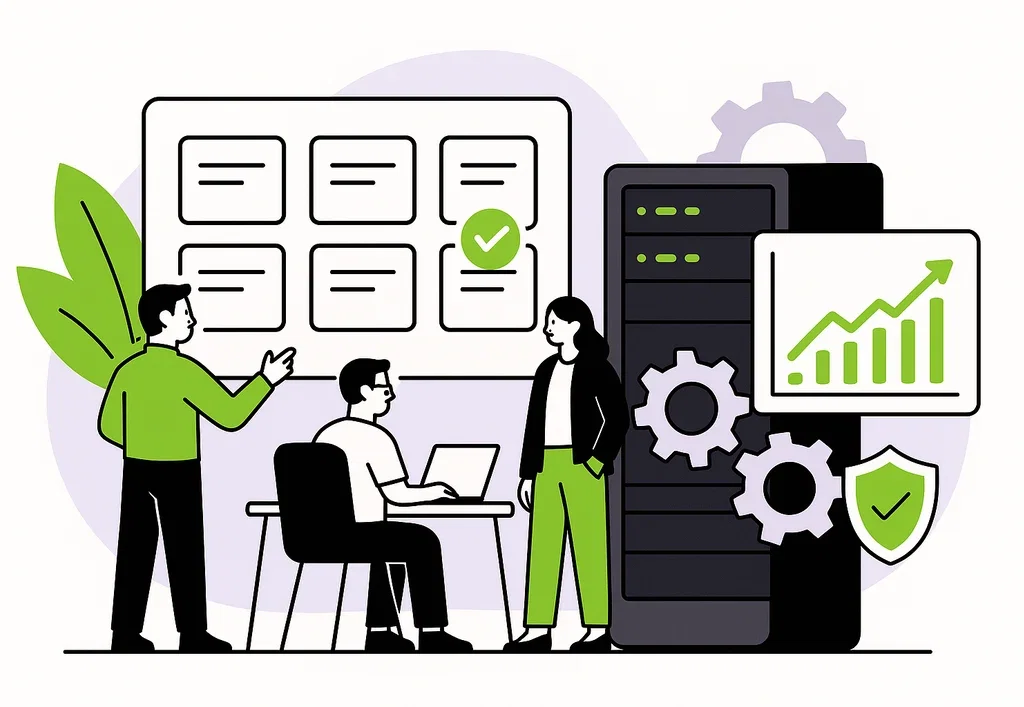





DevOps Overwhelmed by Modern Complexity
DevOps has revolutionized IT operations since 2010: Dev+Ops collaboration, automation, continuous delivery. But a new reality is emerging.
Cloud environments, microservices, and containers generate a deluge of data. According to the AIOps Exchange study (2019), 40% of large organizations receive over one million alerts per day (source).
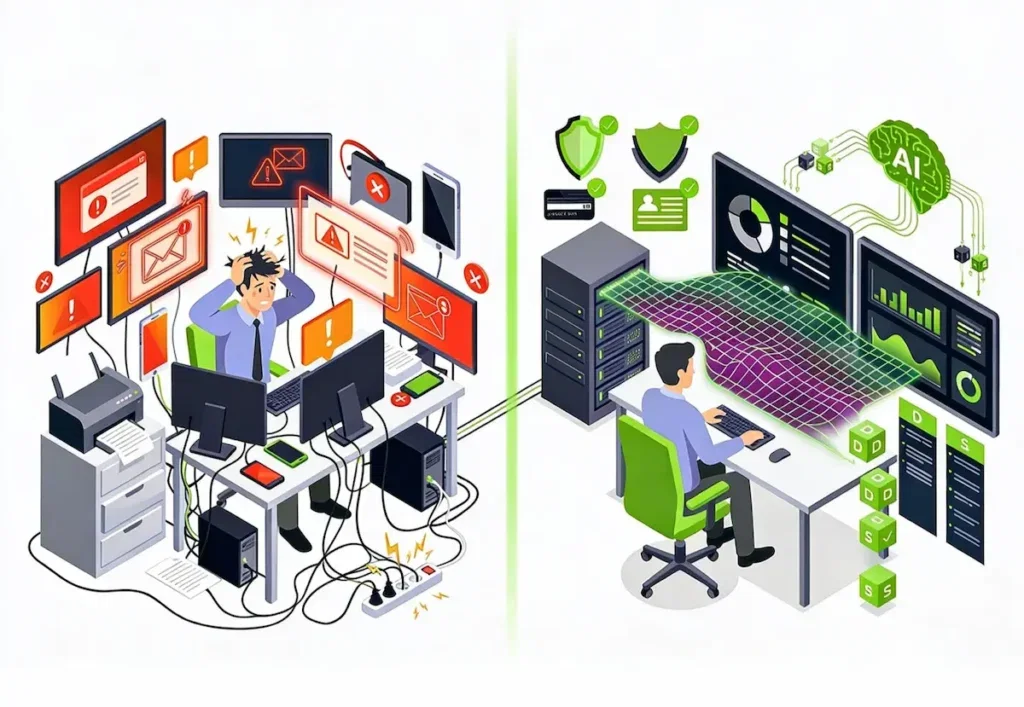
The result: alert fatigue. IT teams, overwhelmed, become desensitized to notifications. Critical incidents go unnoticed, buried in noise.
Manual monitoring no longer scales. Dashboards multiply. Reactive troubleshooting shows its limits against exponentially complex infrastructures.
AIOps was born in 2016. Gartner created this term to designate the application of artificial intelligence to IT operations. The objective: transform chaos into actionable insights and shift from reactive to predictive.
What is AIOps?
AIOps (Artificial Intelligence for IT Operations) applies AI (machine learning, NLP, big data) to automate and improve IT operations.
Unlike traditional tools that rely on static thresholds, AIOps learns from historical patterns to detect anomalies, correlate events, and anticipate problems.
The 6 Key Capabilities of AIOps
- Data aggregation: Unifies logs, metrics, events, tickets, distributed traces
- Anomaly detection: Automatically identifies deviations from normal behavior
- Event correlation: Groups related alerts into coherent incidents with context
- Root cause analysis: Automatically traces causality chains between components
- Automated remediation: Triggers actions (restart, scaling, rollback) without human intervention
- Incident prediction: Alerts before a problem materializes
AIOps Doesn’t Replace DevOps
AIOps is an intelligence layer on top of DevOps foundations (CI/CD, IaC, collaboration). DevOps lays the tracks, AIOps drives the train intelligently.
Why Traditional DevOps No Longer Suffices
Unmanageable Scale
Teams grow linearly. IT complexity grows exponentially. The equation doesn’t hold.
An application deployment involves dozens of microservices, each emitting logs, metrics, and traces. A NOC engineer cannot simultaneously monitor ten dashboards with constant vigilance.
Alert Fatigue: Drowning in Noise
40% of large organizations receive +1M alerts/day (AIOps Exchange, 2019). Teams develop desensitization. Some alert categories are disabled to reduce noise, risking missed critical incidents.
Static thresholds generate false positives. A predictable traffic spike triggers an alert. Noise masks real problems.
Data Silos
APM, logs, ticketing, infrastructure, traces: each tool generates data in its own silo. Engineers manually navigate between systems to correlate events. The process is slow, error-prone, and directly impacts MTTR.
AIOps addresses these three challenges by transforming chaos into actionable insights.
The 4 Transformations Brought by AIOps
1. From Reactive to Predictive
Before: Incident → alert → investigation → resolution (reactive)
With AIOps: Pattern analysis → prediction → preventive action
Concrete examples:
- Detect that a server will run out of disk space in 48h
- Predict a service crash by identifying a progressive memory leak
- Anticipate performance degradation during load increase
Benefit: Problems are resolved before user impact. Unplanned downtime drastically reduced.
2. From Alert to Signal
Before: A service degradation triggers 15 distinct alerts from different tools. Unbearable noise.
With AIOps: Intelligent correlation. A single enriched incident with complete context.
Example: “Critical incident: API Latency +500ms. Probable cause: PostgreSQL connection pool saturation following v2.3.1 deployment 8 min ago. 5 services impacted, 1200 users affected.”
Benefit: 60-80% reduction in alert volume. Teams focus on real problems.
3. From Manual Investigation to Auto-RCA
Before: Manual investigation takes hours. Consult multiple logs, check metrics, analyze traces, examine deployment history.
With AIOps: Automatic Root Cause Analysis in seconds. AIOps builds a dependency graph, analyzes temporal correlations, traces the causality chain.
67% of IT organizations with AIOps observe a significant reduction in incident response times (Business Research Insights).
Benefit: MTTR reduced by 40-70%.
4. From Manual to Auto-Healing
Before: Human identifies → human decides → human executes
With AIOps: Detection → analysis → decision → automated remediation → verification
Typical automated actions:
- Restart unresponsive service
- Horizontal scaling of Kubernetes cluster under load
- Rollback deployment generating errors
- Purge saturated caches
Limitation: Human oversight remains necessary for high-risk actions (prod DB modifications, critical network configs).
Benefit: Resolution in seconds/minutes instead of hours.
Adoption and ROI
Leading Tools
Datadog, Splunk (ITSI), Dynatrace, New Relic, IBM Watson AIOps, Moogsoft, BigPanda, PagerDuty.
Two approaches:
- Domain-centric: AI applied to a specific domain (APM, network, logs)
- Domain-agnostic: Unified multi-source platform
Accelerated Adoption
65% of IT leaders consider AIOps “important or very important” for managing network/cloud performance (Masergy & ZK Research, 2021, source).
84% see AIOps as a path toward fully automated network environments. 86% expect an automated network within 5 years.
Gartner predicted in 2018 that 30% of large enterprises would exclusively use AIOps by 2024 (source).
Measured ROI
- MTTR: 40-75% reduction. Telecom case with Splunk: MTTR from 180 min → 45 min
- Alert noise: 60-80% reduction
- Prevention: Incidents resolved before user impact
- Engineer time: Freed from firefighting, focus on innovation
- Operational costs: 20-40% reduction
AIOps Challenges
Data Quality
AIOps = garbage in, garbage out. ML doesn’t compensate for incomplete, inconsistent, or erroneous data. Poorly structured logs, irregular metrics, missing events = unreliable predictions.
Integration Complexity
Connecting AIOps to the IT ecosystem = heavy technical project. Integrate monitoring, logs, ticketing, CMDB, CI/CD, collaboration. Legacy systems pose significant challenges.
Skills Gap
Rare hybrid profiles: DevOps + ML. Training teams or recruiting = costly and lengthy. Configuring ML models (tuning, baselines, thresholds) requires expertise.
Non-Deterministic Behavior
ML isn’t 100% predictable. False positives, false negatives, “black box” decisions. Human oversight necessary for critical decisions.
Cultural Resistance
“Will AI replace me?” Resistance often underestimated. Success = change management, transparent communication, team involvement from the start.
What’s After AIOps? The AgentOps Horizon
AIOps has transformed monitoring and analysis by bringing predictive intelligence to IT operations. But it remains fundamentally a recommendation system: it detects, analyzes, and suggests. Humans decide and execute.
The next revolution is already underway: AgentOps. Where AIOps observes and advises, AgentOps acts autonomously. AI agents capable of planning, executing complex workflows, coordinating with each other, and learning from their actions.
If AIOps is an intelligent copilot, AgentOps is an autonomous pilot under human supervision.
In our next article, we’ll explore how AgentOps is redefining IT operations: autonomous orchestration, multi-task agents, and the shift from artificial intelligence to artificial action.
Conclusion
DevOps laid the foundations. AIOps adds the intelligence needed to manage scale and complexity.
65% of IT leaders consider AIOps critical. Adoption is accelerating. Organizations that don’t adopt AIOps risk being left behind, unable to effectively manage their infrastructures and maintain expected SLAs.
But AIOps is only a step. The horizon is emerging with AgentOps, where AI no longer advises. It acts autonomously. The transformation of IT operations continues.
 Équipe Castelis
 11 min
 08 Sep 2026